
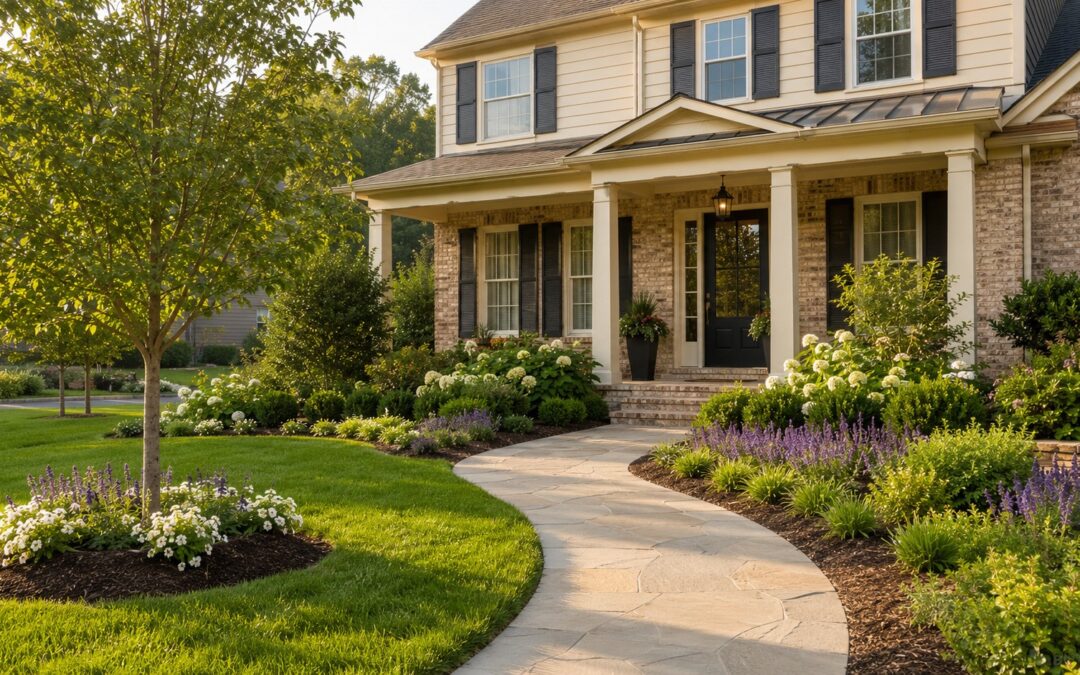
First impressions start at the street. Before anyone notices your front door or your porch, they see the lawn, the beds, and the trees. They see the walkway that leads up to the house. Landscaping shapes that impression more than almost any other exterior feature. In Georgia it does so for most of the year. Our long growing season means a front yard is on display from early spring through late fall. Evergreens carry the load through winter.
Curb appeal matters for more than pride of ownership. Buyers form opinions from the driveway. Real estate agents consistently point to exterior presentation as one of the first things prospective buyers react to. Beyond that, a neat, well planned front yard signals that the rest of the property has been cared for. Even if selling is years away, a front yard you enjoy pulling up to every day is worth the effort.
Georgia presents a specific set of conditions that shape what works and what does not. Heavy clay soil in the Piedmont and sandy soil in the Coastal Plain call for different approaches. Hot and humid summers, periodic drought, and heavy spring pollen all affect plant choices and maintenance. This guide covers seven improvements that make a visible difference. Each one includes practical notes on adapting it to conditions across the state.
Know Your Georgia Growing Conditions First
A little groundwork saves a lot of money. Plants that thrive in one part of Georgia can struggle in another, and soil varies dramatically by region.
Hardiness zones. According to the current USDA Plant Hardiness Zone Map, Georgia spans roughly Zone 6b to Zone 9a. The coldest zones are in the highest elevations of the north Georgia mountains, and the warmest are along the coast. Metro Atlanta falls in Zone 8a. These zones reflect average annual minimum winter temperatures and determine which plants can survive the cold. Always check the zone rating on a plant tag before buying.
Soil. The Piedmont region, which includes Atlanta and stretches from the fall line north to the mountains, is dominated by red clay. Clay holds water and nutrients well but drains slowly and compacts easily. South of the fall line, the Coastal Plain has sandier soil that drains fast and holds fewer nutrients. Many suburban lots in both regions also have topsoil that was scraped away during construction, leaving compacted subsoil that needs amendment.
Soil testing. The University of Georgia Cooperative Extension offers low cost soil testing through county extension offices statewide. A basic test reports pH and nutrient levels and comes with recommendations for lime and fertilizer. Georgia soils are often acidic, and many lawn grasses and ornamentals perform poorly until pH is corrected. Testing before you plant or fertilize is one of the highest value steps you can take.
Water. Summers are hot and humid, but rainfall is uneven. Georgia experiences periodic droughts, and the state has a history of outdoor watering restrictions during dry years. Under the Georgia Water Stewardship Act of 2010, outdoor landscape watering is generally allowed daily between 4 p.m. and 10 a.m., with certain exceptions such as drip irrigation and newly installed plants. Local governments can impose stricter rules during declared drought conditions, so check with your water provider.
Pollen and humidity. Spring pollen in Georgia is heavy, and summer humidity encourages fungal diseases such as powdery mildew and brown patch. Plant choices and spacing that allow good air circulation help reduce these problems.
With those basics in mind, here are the seven improvements.
1. Fix the Lawn, or Rethink It
The lawn is the largest single element in most front yards, and its condition sets the tone for everything else. A patchy, weedy lawn undermines even the best plantings. Healthy turf makes the whole property look cared for.
The first decision is grass type, and it depends heavily on where you live. Warm season grasses dominate most of Georgia. Bermudagrass tolerates heat, drought, and heavy foot traffic and is common across the state, though it requires full sun. Zoysiagrass offers a dense, attractive turf with somewhat better shade tolerance than bermuda and is popular in metro Atlanta. Centipedegrass is widely used in south Georgia because it tolerates acidic, sandy soil and needs little fertilizer. St. Augustinegrass is found mainly in coastal areas and handles shade better than most warm season grasses but is less cold hardy.
Tall fescue is the main cool season option and is used primarily in north Georgia, where summers are slightly milder. It stays green in winter when warm season grasses go dormant and brown. The trade off is that fescue struggles in Georgia’s summer heat and typically needs overseeding each fall to stay thick.
Whichever grass you have, the fundamentals are the same. Mow at the correct height for the species. Water deeply and infrequently rather than a little each day, and fertilize according to a soil test rather than a calendar. Core aeration helps compacted clay soils considerably. Warm season grasses respond best when aerated in late spring or early summer during active growth.
For shaded lots, which are common in Georgia’s wooded subdivisions, consider whether a lawn is the right choice at all. Grass under heavy tree canopy is a constant struggle. Replacing thin turf with shade tolerant groundcovers, mulched beds, or a mix of ferns and shade perennials often looks far better. It also requires less work. Avoid English ivy, which is invasive in Georgia and damages trees and structures.
2. Define Beds With Clean Edges and Fresh Mulch
Few improvements deliver more visual impact per dollar than crisp bed edges and a fresh layer of mulch. Defined edges create a clear boundary between lawn and planting areas, which reads as intentional and tidy from the street.
Edging can be as simple as a trench cut with a spade or half moon edger. Permanent options include steel, aluminum, brick, or stone. Natural trench edges look clean and cost nothing beyond labor, but they need recutting a few times each growing season. Hard edging holds its line and keeps bermudagrass and other spreading grasses from creeping into beds. That is a persistent battle in Georgia yards.
Mulch is where Georgia landscapes have a distinctive look. Pine straw is the traditional choice across much of the state, and Georgia is one of the leading producers of it. It is inexpensive, easy to spread, and suits the informal, wooded character of many Georgia neighborhoods. Pine straw does break down relatively quickly and needs refreshing at least once a year. Shredded hardwood and pine bark mulches last longer and give a more formal appearance.
Whatever you choose, apply mulch two to three inches deep. Keep it pulled back a few inches from the trunks of trees and shrubs. Piling mulch against a trunk holds moisture against the bark and invites rot and pests. Keep mulch away from the foundation of the house as well. Subterranean termites are common throughout Georgia, and mulch touching siding or foundation walls gives them cover to reach the structure.
3. Get Foundation Plantings Right
Foundation plantings are the shrubs and small plants that sit along the front of the house. Their job is to soften the transition between the building and the ground and to frame the entry. Done well, they make a house look settled into its lot. Handled poorly, they hide windows, block walkways, and make the house look neglected.
The most common mistake in Georgia yards is overgrown foundation shrubs. Plants that were small and appropriate when installed, such as hollies, ligustrum, and loropetalum, keep growing. In our long season they can reach eight feet or more if left alone. Shrubs that swallow windows or lean over the front walk are a clear signal that a yard needs attention.
Start by assessing what you have. Shrubs that have been sheared into tight shapes for years often have a dense outer shell with bare interiors. They may not recover well from hard pruning. Some species tolerate severe cutback and will regrow from old wood, while others will not. When in doubt, replacement is often the better investment.
For new plants, match the mature size to the space. A shrub labeled to reach six feet will reach six feet, no matter how small it looks in the container. Look for compact and dwarf cultivars for spaces under windows. Layer plantings with taller shrubs at corners and behind, medium shrubs in the middle, and low plants or groundcovers in front. Leave a gap of at least a couple of feet between mature plant size and the house wall. That space allows air circulation and maintenance access.
Reliable choices for Georgia foundation beds include dwarf hollies, compact loropetalum, dwarf abelia, and evergreen azaleas for shade. Boxwood is widely used, but boxwood blight has been confirmed in Georgia and can devastate plantings. Consider disease resistant cultivars or alternatives. Avoid planting nandina if birds visit your yard, as the berries contain compounds that are toxic to some bird species.
4. Plant a Tree, or Take Care of the Ones You Have
Trees are the single largest living investment in a landscape, and they have an outsized effect on curb appeal. A well placed shade tree frames the house, cools the yard, and adds a sense of permanence. Mature trees are also consistently associated with higher property values in real estate and forestry research.
If your front yard lacks a tree, planting one is a long term improvement that starts paying off within a few years. Fall is the best time to plant trees and shrubs in Georgia. Cooler air temperatures reduce stress on the plant while the soil stays warm enough for roots to grow through winter. The tree is then well established before summer heat arrives.
Choose species suited to your region and your lot. Native options with strong curb appeal include flowering dogwood, eastern redbud, southern magnolia, and various oaks. Crape myrtle is not native but is extremely well adapted to Georgia and provides summer bloom and attractive bark. Live oak is the state tree and thrives along the coast but is not reliably cold hardy in the northern half of the state. Think carefully about mature size and placement relative to the house, driveway, power lines, and underground utilities. Before digging, call 811 to have utility lines located, which Georgia law requires for excavation work.
Existing trees need attention too. Remove dead limbs, which are both an eyesore and a hazard. Have large trees inspected by a certified arborist if you notice dieback, fungal growth at the base, or leaning. Avoid the practice known as topping, where the main limbs of a tree are cut back to stubs. It weakens the tree and produces ugly, poorly attached regrowth. Crape myrtles in particular are often cut back to thick stubs every winter. The habit is so common in the South that it has earned the nickname crape murder. Properly pruned crape myrtles need only light thinning and removal of crossing branches.
Also be aware that many Georgia municipalities have tree ordinances. The City of Atlanta, for example, requires a permit to remove trees above a certain size. Other cities and counties in the metro area have similar rules. Check local requirements before removing any sizable tree.
5. Add Color and Seasonal Interest
A yard that is all green can look flat, even when it is well maintained. Layering in color and texture that changes through the seasons gives a front yard life and draws the eye toward the house.
Georgia’s climate supports an exceptionally long bloom season. Camellias flower in fall and winter. Azaleas, dogwoods, and redbuds carry spring. Hydrangeas, crape myrtles, and a wide range of perennials fill summer. Fall brings foliage color from maples, dogwoods, and oakleaf hydrangea, along with late bloomers such as asters. Muhly grass sends up pink plumes that are a highlight of October across the state.
Native and well adapted perennials offer the most reliable performance with the least input. Coneflower, black eyed Susan, coreopsis, and salvia handle heat and periodic drought once established. Oakleaf hydrangea, a Southeastern native, provides white summer blooms, striking fall color, and peeling winter bark in a single plant. American beautyberry produces clusters of bright purple berries in fall that are hard to miss from the road.
The University of Georgia and the state’s green industry maintain the Georgia Gold Medal Plant program. It recognizes plants that perform well across the state. The list is a useful reference when you are unsure what to choose.
Use annuals for concentrated color near the entry. Containers flanking the front door or a small bed along the walkway can be refreshed seasonally. Pansies and violas handle Georgia winters well, while summer options need heat tolerance and regular water. Keep annual displays modest and close to the house, where they have the most impact.
Remember that not every plant sold in Georgia is a good choice for Georgia. Callery pear, commonly sold as Bradford pear, has been widely planted for its spring bloom. It has weak branch structure and spreads aggressively into natural areas. Chinese privet, English ivy, and Japanese honeysuckle are established invasives across the state. Removing these from your property and replacing them with better choices improves both your yard and the surrounding environment.
6. Upgrade the Walkway, Driveway Edges, and Lighting
Hardscape is the framework that plants sit within, and it strongly affects how a front yard reads from the street. A cracked concrete walk or a driveway with crumbling edges will pull attention away from everything else.
Start with the path to the front door. It should be wide enough for two people to walk side by side, generally at least four feet. The route should lead clearly from the driveway or sidewalk to the entry. Narrow, straight, poured concrete walks are common in older Georgia subdivisions and can be replaced or widened with pavers, brick, or flagstone. A gently curved path with planting on either side is more inviting than a rigid line. If a full replacement is not in the budget, pressure washing, repairing cracks, and adding planted borders can make a big difference.
Driveway edges are often neglected. Grass creeping over the edge, bare dirt, or a gap between concrete and lawn all look unfinished. A row of pavers or a mulched planting strip along the drive creates a clean transition.
Landscape lighting extends curb appeal into the evening and adds a measure of safety. Low voltage LED systems are efficient and relatively simple to install. Focus on lighting the path to the door, illuminating the house number, and highlighting one or two specimen trees or architectural features. Resist the urge to light everything. A few well placed fixtures look far better than a runway of path lights. Solar fixtures are inexpensive but typically produce weak light and have short lifespans. Wired low voltage systems are usually the better long term choice.
Georgia’s heavy rain events make drainage part of any hardscape discussion. Standing water near the foundation, washed out mulch, and erosion channels through beds are common problems on clay soils. Address grading and drainage before installing new hardscape, and consider permeable pavers or a dry creek bed to handle runoff attractively.
7. Prune, Clean, and Maintain Consistently
The final improvement is less a project than a habit. Even a beautifully designed front yard loses its appeal within a season if it is not maintained. Conversely, a modest landscape that is consistently neat often looks better than an elaborate one that has been let go.
Pruning is the most visible maintenance task. Learn the correct timing for each plant. Spring flowering shrubs such as azaleas and forsythia bloom on wood formed the previous year and should be pruned right after flowering. Cutting them in late summer or winter removes the next season’s flowers. Summer bloomers such as crape myrtle and many hydrangeas are pruned in late winter. Evergreen hedges can be lightly shaped several times through the growing season. Georgia’s long season means growth continues later into the year than in northern states, so plan for a late season tidy up.
Weed control is a constant in our climate. Mulch suppresses much of it. A pre emergent herbicide applied at the right time can prevent crabgrass and other annual weeds in lawns. For beds, hand pulling after rain, when the clay is soft, is often the most effective approach.
Fire ants are present throughout Georgia and build conspicuous mounds in lawns and beds. Treating mounds promptly keeps the yard both safer and better looking.
Clean surfaces matter as much as plants. Pressure wash walkways, the driveway, and any hardscape at least annually to remove the mildew and algae that thrive in Georgia’s humidity. Rinse pollen off surfaces in spring. Keep gutters clear so overflow does not wash out beds below.
Finally, walk to the street once a month and look at your house the way a visitor would. Small problems, such as a dead shrub, a leaning fixture, or a bed that has lost its edge, are easy to fix when caught early. They are just as easy to overlook when you see the yard every day from the driveway.
A Few Practical Notes Before You Begin
Homeowners associations govern a large share of suburban Georgia. If you live in one, review the covenants before making significant changes. Many associations regulate tree removal, fence styles, hardscape materials, and even plant choices in front yards.
Set priorities based on visibility and cost. Lawn repair, bed edging, mulch, and pruning are inexpensive and immediately noticeable. Trees and hardscape cost more and take longer to pay off but have the greatest long term effect.
Consider timing. Fall is ideal for planting trees, shrubs, and many perennials in Georgia. Spring is the busiest season for landscape contractors, so schedule larger projects early. Avoid major planting in the peak heat of July and August, when establishment is difficult and water demands are highest.
For plant selection, soil questions, or pest identification, your county UGA Extension office is a free and reliable resource with information specific to Georgia conditions.
Final Thoughts
Curb appeal is not about having the most elaborate yard on the street. It comes from a front yard that looks intentional, healthy, and cared for. Georgia gives homeowners a long season and a wide palette of plants to work with, along with some real challenges in soil, heat, and water.
Work through these seven improvements in whatever order fits your budget and schedule. Hire a professional Georgia landscaper to handle it for you. Start with the fundamentals of lawn, edges, and pruning, then build toward the larger investments in trees and hardscape. Each step makes the next one look better. The result is a home that makes a strong impression from the moment someone turns onto your street.