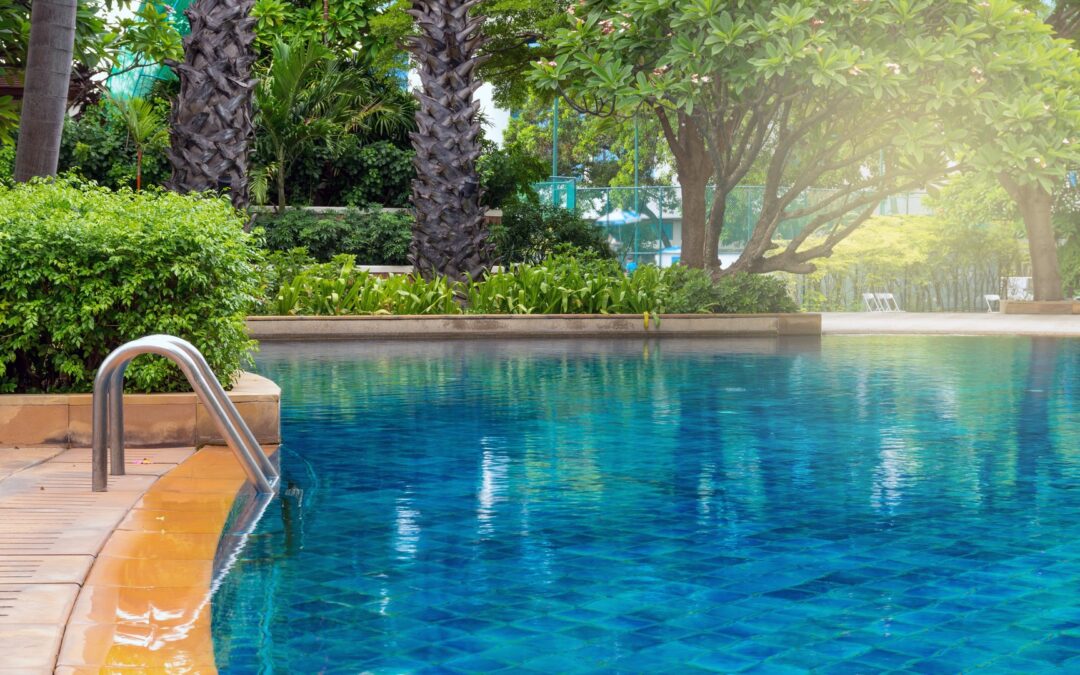
A pool in Atlanta gets used. The swim season here runs roughly from late April through October, and on the hottest days the backyard is the most-used room in the house. What surrounds the pool matters as much as the pool itself. The right plants give you privacy from neighbors, soften hardscape, screen out HVAC units and pool equipment, and turn the whole space into the resort backyard you were picturing when you signed the contract. The wrong plants give you a maintenance problem you’ll resent every weekend for the next twenty years.
Atlanta’s climate makes this both easier and trickier than people expect. We have a long growing season, plenty of rain, and enough heat to grow things that wouldn’t survive a hundred miles north. We also have heavy pollen seasons, intense summer sun, and a parade of debris-dropping native trees that can turn a clean pool into a green soup overnight. This guide walks through what actually works around a metro Atlanta pool — what to plant, what to keep far away, and how to think about layout — so you end up with something beautiful that doesn’t fight you.
Atlanta’s Growing Conditions, Briefly
Most of metro Atlanta sits in USDA hardiness zones 7b and 8a, with the 2023 USDA map shifting parts of the area into 8a and 8b based on milder recent winters. The urban core runs warmer than the outer suburbs because of the heat island effect — downtown Atlanta and the inside-the-perimeter neighborhoods can stay 5 degrees warmer than Cherokee or Forsyth on a January night. Practically, that means winter lows generally bottom out in the 10s, occasionally dipping into the single digits during a hard freeze.
For a pool landscape, this opens up a much wider plant palette than you’d have in Tennessee or the Carolinas, including some palms and tropical-looking plants that a lot of homeowners assume they can’t grow here. It also means you have to plan for the brutal middle of the summer, when reflected heat off the pool deck and paving can push surface temperatures to triple digits. Plants that nominally tolerate full sun sometimes struggle in that microclimate.
Soil matters too. Most of the metro is on red Georgia clay, which holds water, drains slowly, and compacts hard. Pool excavation makes it worse — backfill around a pool is often heavy clay or fill dirt with poor structure. Anything you plant within a few feet of the pool should either tolerate that, or you should amend the soil heavily before planting.
What to Look for in a Pool Plant
Before getting to specific recommendations, it’s worth being clear about the criteria that actually separate a good poolside plant from a bad one. The same plant can be brilliant in one yard and a disaster in another based on a few factors:
Debris load. Anything that drops leaves, flowers, fruit, sap, seed pods, or bark in large quantities will end up in the pool, in the skimmer, or in the filter. Some debris is unavoidable. The goal is to minimize it close to the water.
Root behavior. Aggressive, water-seeking roots can crack pool decking, lift pavers, invade plumbing, and in worst cases damage the pool shell. Willows, mulberries, silver maples, sweetgums, and ficus are all infamous for this. The general rule is to plant any tree at least 10 to 15 feet from the pool wall, more for fast-growing species.
Pollinator attraction. Bees and wasps near a pool are a real problem, especially with kids around. Pools attract bees on their own — they’re drawn to the water. Adding heavily nectar-producing plants right next to the deck stacks the deck against you. Plant the bee-friendly stuff at the back of the yard.
Thorns and sharp foliage. Roses, certain hollies, agave, yucca, and barberry all earn their place in many landscapes, but not where wet, barefoot people will walk past them. Set them back, or pick a smoother alternative.
Splash tolerance. Pool water has chlorine or salt (with saltwater systems), and splashes will hit nearby foliage. Most established shrubs handle occasional splashes fine, but some delicate plants will brown out.
Year-round appearance. Atlanta winters are mild but real. A landscape that looks great in July and like sticks in January will disappoint you for half the year. Mixing evergreens with deciduous flowering plants gives you both color and structure.
Trees That Work Around an Atlanta Pool
Tall vertical structure is what makes a pool feel like a destination instead of a slab in the yard. The trick is finding trees that give you height without dumping leaves or punching roots through the deck.
Windmill palm (Trachycarpus fortunei). This is the workhorse cold-hardy palm for metro Atlanta. It tolerates winter lows well into the single digits once established and reads as authentically tropical in a poolscape. Slow-growing, modest root system, minimal debris. Plant in groups of three at varying heights for the best look.
Needle palm (Rhapidophyllum hystrix). Native to the Southeast, ridiculously cold-hardy (rated to about 10°F with brief drops lower), and tolerant of the wet feet you sometimes get near a pool. Forms a clumping, fan-leaved mound 4 to 6 feet tall. Great low-growing palm for the corners of a pool deck.
Sago palm (Cycas revoluta). Technically a cycad, not a true palm, but it gives you that resort-style symmetry. Slow-growing, shallow roots, very little debris. Important caveat: sago palms are highly toxic to dogs and small children if any part is ingested. If you have either, skip this one.
Crape myrtle. Practically the official tree of Atlanta summer. Long-blooming, drought-tolerant, well-adapted to clay soil, and available in a huge range of sizes from 4-foot dwarfs to 30-foot specimens. The tradeoff is that they shed flowers, seed capsules, and bark — so site them at least 15 feet from the pool, ideally downwind. The ‘Natchez’ and ‘Muskogee’ cultivars are popular larger forms; ‘Acoma’ or ‘Tonto’ work in smaller spaces.
Eastern redbud (Cercis canadensis). A native understory tree that puts on a spectacular pink-purple show in early spring and stays a manageable size (20–30 feet). Modest root system, deciduous but not particularly messy. The ‘Forest Pansy’ cultivar has burgundy foliage that reads beautifully against pool tile.
Flowering dogwood (Cornus florida). Another Georgia native, lovely four-season interest, well-mannered roots. Best sited in part shade where it can get afternoon protection. Keep it 15 feet from the pool to manage flower and leaf drop.
Italian cypress (Cupressus sempervirens). For a Mediterranean or modern look, nothing else gives you that vertical exclamation point. Drought tolerant, low debris, narrow footprint. They can struggle with humidity-related needle blight in the deep South, so give them good air circulation and don’t crowd them.
‘Green Giant’ arborvitae (Thuja standishii × plicata). The go-to evergreen privacy screen in metro Atlanta. Fast-growing (3 to 5 feet a year once established), reaching 30 to 40 feet, dense to the ground. Better than Leyland cypress, which has been hammered by canker disease throughout the Southeast over the last decade and is no longer recommended. Plant ‘Green Giants’ along the back fence line, not right at the pool edge.
Little Gem magnolia. A compact southern magnolia cultivar that tops out around 20 feet. Evergreen, glossy leaves, fragrant white blooms in summer. The leaves are leathery and drop year-round in small numbers, so place it where it screens rather than overhangs the water.
Shrubs for Structure and Screening
Shrubs do the real work in a pool landscape. They define the edges, hide pool equipment, and create the layered backdrop that makes flowers and ornamental grasses look intentional instead of random.
Boxwood (Buxus). The classic choice for clean, formal lines. ‘Green Velvet’ and ‘Winter Gem’ both perform well in Atlanta heat. Use boxwood for low hedging along pool decks and to anchor plantings around statuary or pots. Watch for boxwood blight — buy from a reputable nursery and don’t plant boxwood right next to a recently-removed boxwood.
Distylium. A relatively new shrub on the market that’s been gaining ground fast as a boxwood and holly alternative in the South. Evergreen, heat- and humidity-tolerant, no major disease issues, and surprisingly pretty. Cultivars like ‘Vintage Jade’ and ‘Coppertone’ give you different sizes and leaf colors.
Dwarf yaupon holly (Ilex vomitoria ‘Schillings’). A native holly that takes pruning beautifully, tolerates heat and drought once established, and reads almost like boxwood from a distance. No spines on this dwarf variety, which makes it pool-friendly. Larger yaupon hollies can be limbed up into small ornamental trees.
Camellia. Probably the most underused poolside shrub in Atlanta. Both Camellia japonica (winter and early spring blooming) and Camellia sasanqua (fall blooming) thrive here, give you evergreen structure year-round, and bloom when nothing else is. Sasanquas are slightly more sun- and drought-tolerant. Plant them where their winter blooms are visible from inside the house.
Loropetalum (Chinese fringe flower). Burgundy foliage and pink fringe flowers, available in everything from groundcover-sized ‘Purple Pixie’ to 10-foot ‘Zhuzhou’. Evergreen, fast-growing, takes Atlanta heat without complaint. Excellent for color contrast against light-colored pool decking.
Knock Out and Drift roses. If you want roses, these are the only ones to consider for a low-maintenance pool landscape. Disease-resistant, repeat-blooming from spring to first frost, manageable thorns. Drift roses are the ground-cover-sized version. Site them out of the immediate splash zone, since rose foliage can spot when constantly wet.
Soft Caress mahonia. A thornless mahonia cultivar with delicate, fern-like evergreen foliage and yellow winter blooms. Tolerates shade, which makes it useful for the shadier corners that nothing else seems to thrive in.
Flowering Plants and Perennials
The seasonal color is what gives a pool landscape personality. Lean toward perennials that come back without replanting, drought tolerance once established, and minimal flower drop into the water.
Hydrangea. Atlanta is hydrangea country. For pool landscapes, panicle hydrangeas (Hydrangea paniculata) are the better choice over the classic mophead bigleaf types — they tolerate full sun, bloom on new wood (so they don’t get knocked out by a late freeze), and the cone-shaped flower clusters are dramatic. ‘Limelight’, ‘Little Lime’, and ‘Vanilla Strawberry’ are all proven cultivars. Native oakleaf hydrangea (H. quercifolia) is also excellent and gives you fall color.
Daylily. Practically indestructible, blooms reliably, multiplies on its own, comes in every color. Border the pool fence or the pool deck planting beds with them.
Agapanthus (Lily of the Nile). Strappy evergreen foliage with tall blue or white flower spikes in early summer. Tolerates reflected heat, drought, and clay soil. Reads sophisticated and slightly tropical without trying too hard.
Lantana. A summer workhorse for full-sun pool areas. Heat- and drought-tolerant once established, blooms continuously from late spring to frost, attracts butterflies and hummingbirds. Most cultivars sold in metro Atlanta are root-hardy here and return reliably each year.
Salvia. Both annual and perennial salvias do well around Atlanta pools. ‘Black and Blue’ salvia is a hummingbird magnet that grows 3 to 4 feet tall and stays in place without spreading aggressively. ‘May Night’ is a tidier perennial sage that blooms in late spring.
Black-eyed Susan (Rudbeckia). Native, sun-loving, drought-tolerant, and a long bloomer. Pairs well with ornamental grasses for a more naturalistic pool border.
Coneflower (Echinacea). Same use case as black-eyed Susan, with a wider color range now that breeders have moved beyond the classic purple.
Gardenia. The fragrance is the whole point. ‘Frostproof’ is a good cultivar for metro Atlanta — hardier than older varieties and more reliable through winter. Site gardenias near a seating area where the scent will hit you, but not so close to the pool that bee traffic becomes an issue.
The Tropical Look, Atlanta-Style
A lot of homeowners want their pool to feel tropical without having to grow plants that won’t survive winter. Several plants give you the look without the heartbreak.
Hardy banana (Musa basjoo). Genuinely cold-hardy to about -10°F when properly mulched, Musa basjoo dies back to the ground in winter and explodes back to 10 or 12 feet by midsummer. Massive paddle-shaped leaves, instant tropical drama. It does spread, so contain it or commit to dividing it every few years.
Canna lily. Big tropical foliage in green, bronze, or variegated, with showy red, orange, or yellow flowers. Treats winter the same way as banana — dies back, returns reliably. Loves heat, loves humidity, loves Atlanta summer.
Elephant ear (Colocasia and Alocasia). Enormous heart-shaped leaves on tall stems. Many cultivars overwinter reliably in the ground in metro Atlanta if mulched, especially in zone 8a microclimates. ‘Black Magic’ and ‘Mojito’ are show-stoppers near a pool.
Yucca ‘Color Guard’ or ‘Bright Edge’. Variegated yuccas give you that bold architectural form without the sharper-than-it-looks tips of some species. Site them away from the immediate walking zone.
Ornamental ginger (hardy ginger lilies, Hedychium). Aromatic late-summer flowers and lush foliage. Many varieties survive metro Atlanta winters in the ground.
Ornamental Grasses and Ground Covers
Grasses give you movement, vertical texture, and a soft contrast to hardscape — and they’re some of the lowest-maintenance plants on this list.
Pink muhly grass (Muhlenbergia capillaris). The October showstopper. Cloud-like pink plumes, native, drought-tolerant, no debris issues. Use it in masses for maximum effect.
Maiden grass (Miscanthus sinensis). Larger, more upright, with feathery plumes that catch evening light. ‘Morning Light’ and ‘Gracillimus’ are popular cultivars. Cut it back hard in late winter.
Liriope and mondo grass. Both work as low border plants and ground cover. Liriope is the more familiar one — clumping, with purple flower spikes in summer. Black mondo grass (Ophiopogon planiscapus ‘Nigrescens’) makes a striking dark accent against light stone or concrete.
Creeping thyme or sedum. For sunny spots between pavers or along the pool deck edge, low-growing succulents and herbs handle reflected heat better than turf and don’t need mowing.
What Not to Plant
The list of plants to avoid is at least as important as the list to plant. Some of these are gorgeous trees and shrubs that simply don’t belong within fifty feet of a pool.
Sweetgum. The gumballs alone disqualify this tree. Beautiful fall color, but the spiky seed capsules will end up in your pool, in your filter, and in your bare feet for months on end.
Pine. Pine needles are a nightmare around pools. They slip through skimmer baskets, mat together in the filter, and pine sap is acidic enough to pull pool pH down. Pines drop a third of their needles every year regardless of season. If you have existing pines on the property, that’s one thing — but don’t plant new ones.
Bradford pear (and other ornamental pears). Foul-smelling spring bloom, weak limb structure that splits in storms, invasive in Georgia, and they drop everything they have. The state of Georgia has run buyback programs to incentivize their removal. Don’t plant one anywhere.
River birch. Beautiful peeling bark, but they shed bark, leaves, and twigs constantly. Surface-rooted enough to lift decking. Better as a far-back specimen tree, not a pool feature.
Mulberry. The fruit will stain your decking purple. The roots will go after your plumbing. Skip it.
Willow. Water-seeking roots, constant leaf drop, brittle branches in storms. Categorically wrong for a pool.
Silver maple and most maples. Aggressive shallow roots, large leaf drop, soft wood that breaks in wind. Japanese maples are a partial exception — much smaller, better-behaved roots — but even those should be set back from the pool deck.
Mimosa. Fluffy pink flowers, weak wood, invasive, drops everything constantly. There’s a reason older Atlanta neighborhoods are full of self-seeded mimosas. Don’t add to the problem.
Magnolia grandiflora (full-size). Yes, it’s the iconic Southern tree, but those leaves are leathery, large, and drop year-round. A 40-foot magnolia hanging over a pool is a constant cleanup job. The dwarf ‘Little Gem’ is the better pool-area choice.
Running bamboo. Avoid at all costs. It will take over the yard, your neighbor’s yard, and your pool’s plumbing. If you must have bamboo for the look, use a clumping species (Bambusa or Fargesia) and still install a root barrier.
Honeysuckle, jasmine, and other heavily nectar-producing vines. Beautiful and fragrant, but they pull bees in by the thousand. If you want fragrance, plant them at the back fence line, well away from the pool deck.
Roses outside of Knock Out / Drift series. Most traditional roses are too disease-prone and too thorny to be worth it close to a pool.
Oleander. Sometimes recommended for poolside, but every part of the plant is toxic. With kids or pets, don’t.
Layout and Design Principles
A pool landscape should layer in roughly three tiers: tall trees and screening evergreens at the back fence line, mid-height shrubs and ornamental grasses as the middle ground, and low perennials, ground covers, and specimen pots near the deck edge. That layering does most of the work of making the space feel intentional and resort-like.
A few practical guidelines worth following:
Setback distances. Trees go at least 10 to 15 feet from the pool wall, more for anything with aggressive roots. Shrubs can come closer. Perennials and grasses can be right at the edge.
Pool equipment screening. The pump, heater, and filter pad is one of the ugliest parts of a pool. A row of dwarf yaupon holly, distylium, or compact loropetalum hides it without needing maintenance. Make sure to leave 2 or 3 feet of clearance around the equipment for service access.
Mulch choice. Pine straw is the cheap default in Atlanta, but it’s not a great choice right next to a pool because it blows around and decomposes into the water. Hardwood mulch or pine bark nuggets stay in place better. Better still, use river rock, decomposed granite, or pea gravel in the immediate pool perimeter.
Containers near the deck. Big planters give you flexibility — bring tropicals indoors over winter, swap out seasonal color, move things around as the sun angle shifts. Glazed ceramic and concrete planters survive Atlanta winters; terracotta usually doesn’t.
Wind direction. Pay attention to which way the wind blows debris in your particular yard. In most of metro Atlanta the prevailing summer breezes come from the south and southwest. If you have a leaf-dropper north of the pool, that’s actually fine. South of it, that’s a constant cleanup problem.
Saltwater pools. If you have a salt chlorine generator, the splash-out around the deck has a low salt content that can stress sensitive plants over time. Most of the plants on this list handle it without issue, but azaleas and some camellias can struggle if they get repeatedly splashed.
A Final Word
The best pool landscape in metro Atlanta is one that looks great year-round, gives you privacy, doesn’t fight the climate, and doesn’t double your weekly pool maintenance. That generally means leaning toward evergreens for structure, choosing native or proven heat-tolerant flowering plants for color, picking palms and tropicals that actually survive zone 7b/8a winters, and being ruthless about keeping debris-heavy trees away from the water.
Take your time with the design. A lot of homeowners rush the landscape because they spent the budget on the pool and want to be swimming. The plants will be with you longer than the gunite. Pick them well and you’ll spend twenty summers enjoying the result instead of skimming leaves out of the skimmer.